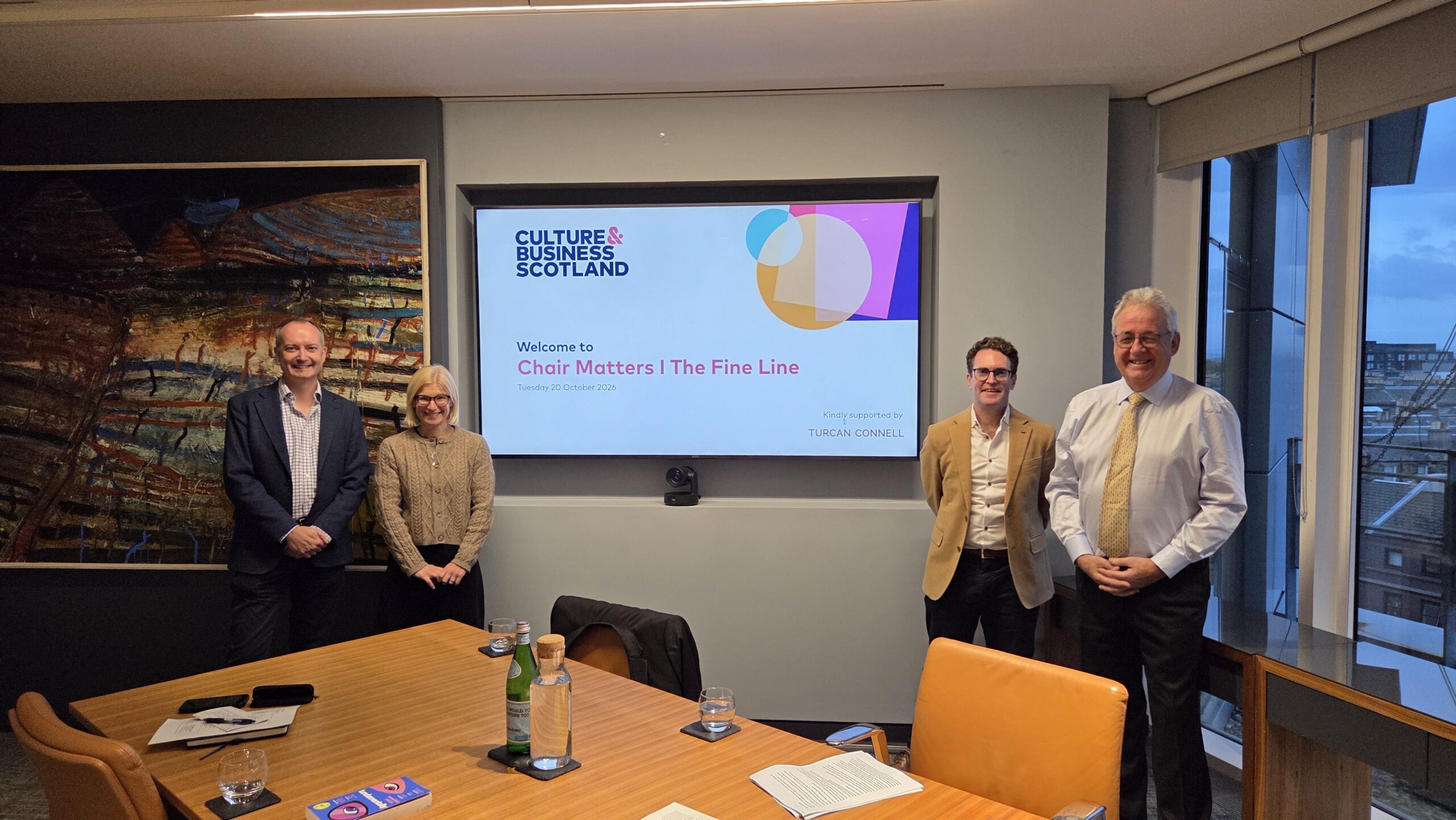
Chairs, Chief Executives and Trustees from around 20 organisations from Scotland’s culture sector joined us for the latest instalment of Chair Matters to examine ‘The Fine Line’ between governance and management at Turcan Connell in Edinburgh on Tuesday 20 October 2026.
Following a welcome from Culture & Business Scotland’s Executive Director, David Nelson, Turcan Connell’s Head of Charities and Partner, Gavin McEwan, gave an overview of his observations as a charity specialist.
Gavin highlighted how the difference between governance and management really matters, as a blurring of the lines between the two, impacts how effectively a Board can maintain an independent perspective, and how well they can exercise proper challenge. He gave some real-life practical examples and noted OSCR’s first inquiry report where two important lessons were set out: it is trustees’ duty not to undermine the chief executive or senior management team; and it is trustees’ duty not to demotivate staff.
Quoting Warren Bennis and Burt Nanus’s 1985 book, Leaders: The Strategies for Taking Charge, Gavin summarised with “Management is doing things right; leadership is doing the right things.” They should work together, not in opposition, and trustees need to focus on their own role and duties, and not to conflate their position with that of the management team.
OSCR’s Senior Manager for Policy and Sector Improvement, Claire Morrison gave a presentation on trustee duties and board dynamics. She emphasised the need for collective responsibility to be taken and that personal interests must not be put before the interests of the charity.
Highlighting how dominance can have a negative impact, she explained that friendships within a Board can be problematic and how bigger characters can sometimes overpower a discussion, when they may just think they’re helping. She encouraged all trustees to consider the impact of their behaviour on the charity and to ensure avoiding processes being bypassed.
Clear recruitment transparency, a good induction programme and forward-looking succession plans can all help to create a strong, collaborative board dynamic that works for the interests of the charity. Claire’s invited attendees to ask “could the charity function if a key individual stepped away?”
Long-standing former company secretary and legal counsel to the Royal Scottish National Orchestra and now accredited mediator, Gordon Murray, offered an outline as to how mediation can help to break the impasse of poor communication, malcommunication and a lack of communication.
Bringing the principle of confidentiality into any mediated discussion helps both parties to give their side of the situation openly, and by applying the concept of lateral thinking, helps to prompt people to consider other views and potentially find unexpected solutions to the problem [situation].
In groups, attendees then worked through three scenarios – one on financial thresholds, one on Board boundaries, and one on mission creep – all situations which OSCR comes across fairly frequently. Claire, Gordon and Gavin brought their expertise into each group discussion, with takeaways shared back into the room for collective wisdom and peer learning.
Key conclusions were drawn out by Gavin:
- Charities need to ensure that their constitutions are fit for purpose, especially when considering how decisions are made and when at short notice. How nimble decision-making can be, whether through online means or by an exchange of emails, is worth reviewing. If your rules do not help you with decision-making processes, then some decisions may lack authority.
- Conversation is good. If you can have difficult conversations, then you may be able to achieve a great deal even if it is painful on the way. Mediation is clearly a very positive opportunity to resolve some problems: that may mean that people are forced to speak. At a minimum, two sides will go away understanding the other much better, even if an ideal resolution is not secured. Greater understanding may be half the battle.
- Remember your role! Trustees can easily forget (through enthusiasm, through a desire to be effective, through a lack of care) that their role is not operational but is strategic. This can be a difficult boundary to maintain in a smaller charity where trustees often need to be more hands-on. A real focus on where the boundaries lie is important and every charity trustee must self-regulate their own behaviour accordingly.
Attendees described the event as “thought-provoking” and expressed how Chair Matters events are crucial in helping them recognise the importance of their own responsibilities and how they should act, whether on the side of governance or of management.
We are hugely grateful to Turcan Connell for hosting this event and look forward to our next chapter coming soon when we examine ‘The Chair and CEO Relationship’.
This event was kindly supported by